
Term deposit
Financial planning
Is it worth putting your money in an Islamic term deposit?
Learn everything you need to know about Islamic term deposits in Malaysia – how they work, how they differ from fixed deposits, profit rate calculations, pros and cons, and what to consider before investing. Includes details on alrajhi bank Malaysia’s Term Deposit-i and special promotional rates.

On this page
- Introduction
- What is an Islamic term deposit?
- How are profit rates for term deposits determined?
- Are Islamic term deposits safe?
- What are the pros and cons of Islamic term deposits?
- How to make an Islamic term deposit placement
- Special Term Deposit-i rates exclusively on MY alrajhi

Looking for a low-risk, Shariah-compliant way to maximize your savings? Islamic term deposits offer a pre-agreed profit return over a set period, without involving interest (riba) and uncertainty (gharar)—making them a popular option for ethically conscious savers.
But exactly how do they work? Let’s explore the basics and help you decide if this type of deposit fits your financial goals.
What is an Islamic term deposit?
An Islamic term deposit is a Shariah-compliant savings product structured under the concept of Commodity Murabahah. This sale-based contract allows you to place a sum of money with the bank for a fixed period in exchange for a predetermined profit rate. The period, or tenure can start from as short as 1 month and go all the way up to 5 years. The most popular periods are typically 3, 6, and 9 months.
Term deposit vs fixed deposit in Malaysia
At first glance, ‘term deposit’ and ‘fixed deposit’ might seem like two names for the same thing— especially since they offer similar economic benefits to depositors. But there is a distinct difference, and it comes down to the type of financial contract behind each product. This is what drives the variation in terminology:
Feature | Coventional Fixed Deposit | Islamic Term Deposit-i |
| Underlying principle | A loan from the customer to the bank. | A trade-based contract (like Commodity Murabahah). |
| Source of return | Interest earned on loaned money. | Profit generated from real economic activity (trading). |
| Terminology | ‘Fixed Deposit’ reflects the fixed interest rate. | Term Deposit-i (with 'suffix i' for Islamic) reflects its compliance with Shariah principles. |
In Malaysia, Islamic term deposits commonly use a hybrid structure based on two core Shariah structures or contracts: tawarruq (commodity murabahah) and supported by wakalah (agency).
Wakalah: First, you appoint the bank as your agent (wakil) to manage and invest your deposited funds on your behalf. Think of the bank as a facilitator managing this process for you.
Tawarruq structure: The bank, acting as your agent, then uses your funds to perform a series of sale and purchase transactions of a specific Shariah-compliant commodity (like crude palm oil or metal) on an approved commodity-trading platform commodity market. It is through this trading activity that the profit for your deposit is generated. This two-part structure ensures your money is not simply being lent out for interest. Instead, it is used in a real trading transaction to generate a legitimate profit, which is then shared with you.
The profit is disclosed upfront and is paid either upon maturity or on a periodic basis. For example, if you place RM10,000 in a 6-month Islamic term deposit with a 3.7% per annum profit rate, you will receive RM10,185 upon maturity (RM10,000 principal plus RM185 profit).
How are profit rates for term deposits determined?
In deposit products like alrajhi bank Malaysia’s Term Deposit-i, the bank acts as your investment agent (wakil) based on the wakalah contract. The bank's role is to place your funds into a portfolio of high-quality, Shariah-compliant assets like sukuk or trade receivables.
As mentioned above, the profit rate for a Term Deposit-i is fixed and agreed upon upfront at the time of placement. This means the rate you accept is the rate you will earn for the entire tenure. The rates that the bank offers to customers are determined by several factors, including:
1. Market conditions, including the Overnight Policy Rate (OPR).
2. The bank’s investment strategy and portfolio performance.
3. The tenure and amount of your deposit.
Are Islamic term deposits safe?
Yes, they are safe. Your principal is fully protected and insured by PIDM (Perbadanan Insurans Deposit Malaysia) up to RM250,000 per depositor. It is also important to note that the entire Islamic banking industry in Malaysia is robustly regulated by Bank Negara Malaysia (BNM). This strong oversight ensures stability and protects consumer rights, building trust and confidence in the system.

Islamic term deposits are suitable for:
1. Conservative savers seeking capital preservation, with the peace of mind that their funds are protected by Perbadanan Insurans Deposit Malaysia (PIDM).
2. Anyone who wants a riba-free savings option.
3. Consumers of all backgrounds who are attracted to ethical and transparent banking.
A significant advantage for all Malaysian depositors is that profit earned from Islamic term deposits is fully exempt from income tax¹. This makes it a highly tax-efficient savings instrument.
What are the pros and cons of Islamic term deposits?
Pros of Islamic term deposits | Cons of Islamic term deposits |
| Capital guarantee: Your principal is protected. | Locked-in rate: Your profit rate is fixed. This is an advantage if market rates fall, but it means you won't benefit if they rise during your tenure. |
| Fixed tenure and profit: Clear duration on how long your deposit is held and how much you will receive. | Modest returns: Profit is generally lower than high-risk investments like stocks, as the focus is on capital safety. |
| Limited liquidity: As with fixed deposits, your money is tied up until maturity; you may face penalties if you withdraw early. |
How to make an Islamic term deposit placement
You typically need:
- A minimum deposit (varies by bank, ranging between RM1,000 to RM5,000)
- To select your preferred tenure
- To accept the agreed-upon profit rate as stated in the contract.
- An existing savings or current account for maturity payouts
Tip: Use a deposit laddering strategy— instead of locking all your savings in a single, long-term deposit, consider splitting your money into several smaller deposits with different end dates (e.g., 3 months, 6 months, and 12 months). This way, you will have more frequent access to your cash while still earning good returns. Remember to check that your chosen tenure aligns with your financial goals, such as saving for a new car in 18 months or a down payment on a house in 2-3 years.
What to consider before making an Islamic term deposit placement?
Before placing your funds in an Islamic term deposit, ask yourself:
1. What is my goal? Are you saving for a short-term goal or long-term growth?
2. Can I afford to lock in my money? Early withdrawals often reduce your profit.
3. What is the tenure like? Choose a duration that matches your savings goals.
4. What are the current profit rates? Some banks offer special promotional rates.
5. How does the bank invest my money? Ensure it aligns with your values.
Special Term Deposit-i rates exclusively on MY alrajhi
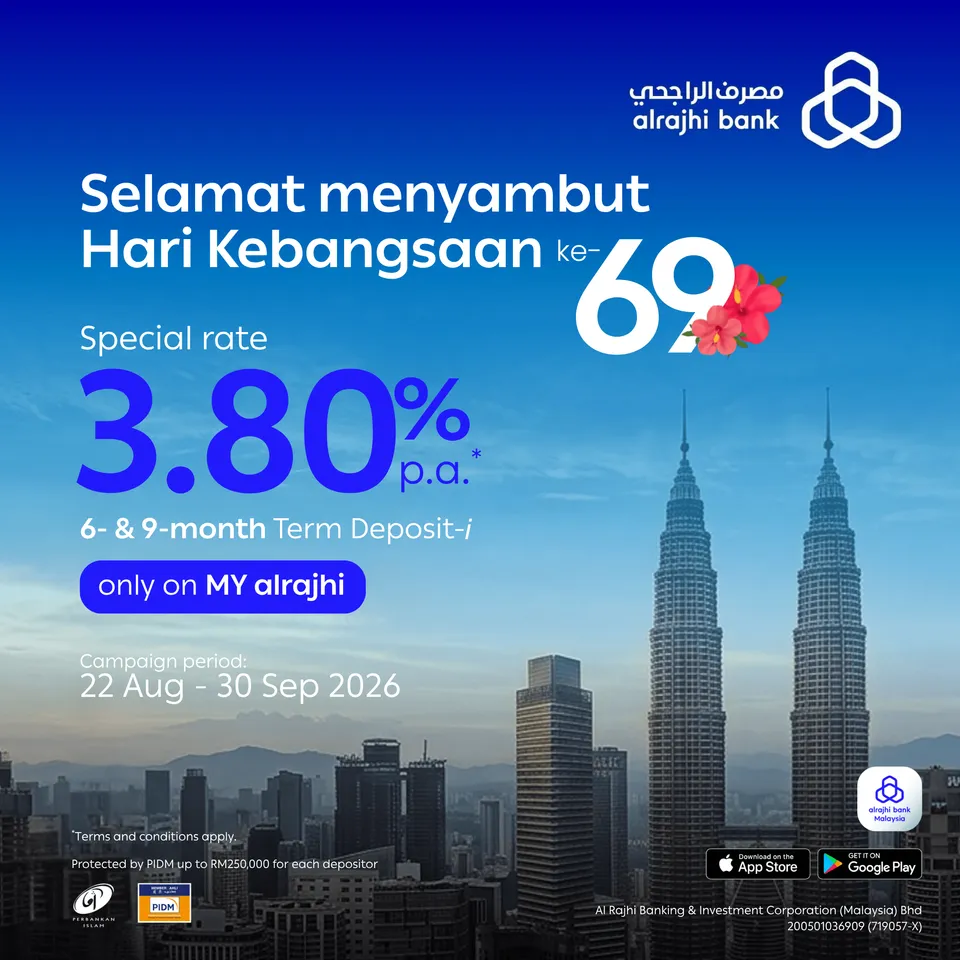
Despite lower OPR conditions impacting saving rates across the industry, alrajhi bank Malaysia is providing customers an opportunity to lock in fixed returns with its latest Term Deposit-i campaign, available exclusively on the MY alrajhi app. From 1 May to 31 December 2026, you can enjoy special profit rates including 3.50% p.a. for a 3-8 months tenure and 3.80% p.a. for a 12-month tenure. This offer is fully digital, requiring no branch visits, and is accessible with a placement starting from just RM500—one of the lowest minimum TD-i amounts in the market. Find out more HERE.
_________________________________________________________________________
¹Malaysia Tax Summaries: Individual - Income determination. PWC Malaysia.
https://taxsummaries.pwc.com/malaysia/individual/income-determination





Discover similar topics

18 November 2025
Budgeting 101: Step-by-step guide to creating a monthly budg...
Learn how to track your income and expenses, choose the righ...
On this page
- Introduction
- What is an Islamic term deposit?
- How are profit rates for term deposits determined?
- Are Islamic term deposits safe?
- What are the pros and cons of Islamic term deposits?
- How to make an Islamic term deposit placement
- Special Term Deposit-i rates exclusively on MY alrajhi